
Montgomery County Court Records After Arrest
A Montgomery County jail arrest follows a path: arrest, booking, initial charge entry, magistrate warnings, bond review, prosecutor screening, and formal court filing. The Montgomery County District Attorney prosecutes felony and many misdemeanor criminal cases depending on offense and court. Mike Holley became Montgomery County District Attorney after being sworn in on October 29, 2025, according to the official DA website context captured in the research file. Court records after a jail arrest are the filed case records, not just the jail booking line.
The difference matters. A booking charge may be the arresting agency's initial entry, a warrant charge, or a charge used for jail intake. After review, a prosecutor may file a complaint, information, or indictment. The court record then becomes the better source for filed charges, settings, dispositions, judgments, and case status. For current custody and jail booking details, use Montgomery County jail inmate records. For booking photos, use Montgomery County jail mugshots.
Find Montgomery County Court Records After Arrest
The official online court search source identified in the research is Montgomery County Odyssey public access. Dynamic field capture was not reliable from static inspection, so search guidance should stay tied to the portal rather than inventing fields. Use defendant name or case number where the portal exposes those search tabs. If a case is too new, older, restricted, sealed, juvenile, or not displayed online, contact the proper clerk.
- Search the Odyssey court portal by defendant name or case number when the portal makes those options available.
- Open the matching case and compare name, filing date, court, and charge text.
- Review the charging document, court dates, bond settings, warrants, and disposition fields when shown.
- Contact the District Clerk or County Clerk for copies, certified records, or records that are not online.
The Odyssey court search portal is the Montgomery County search point for filed case records.
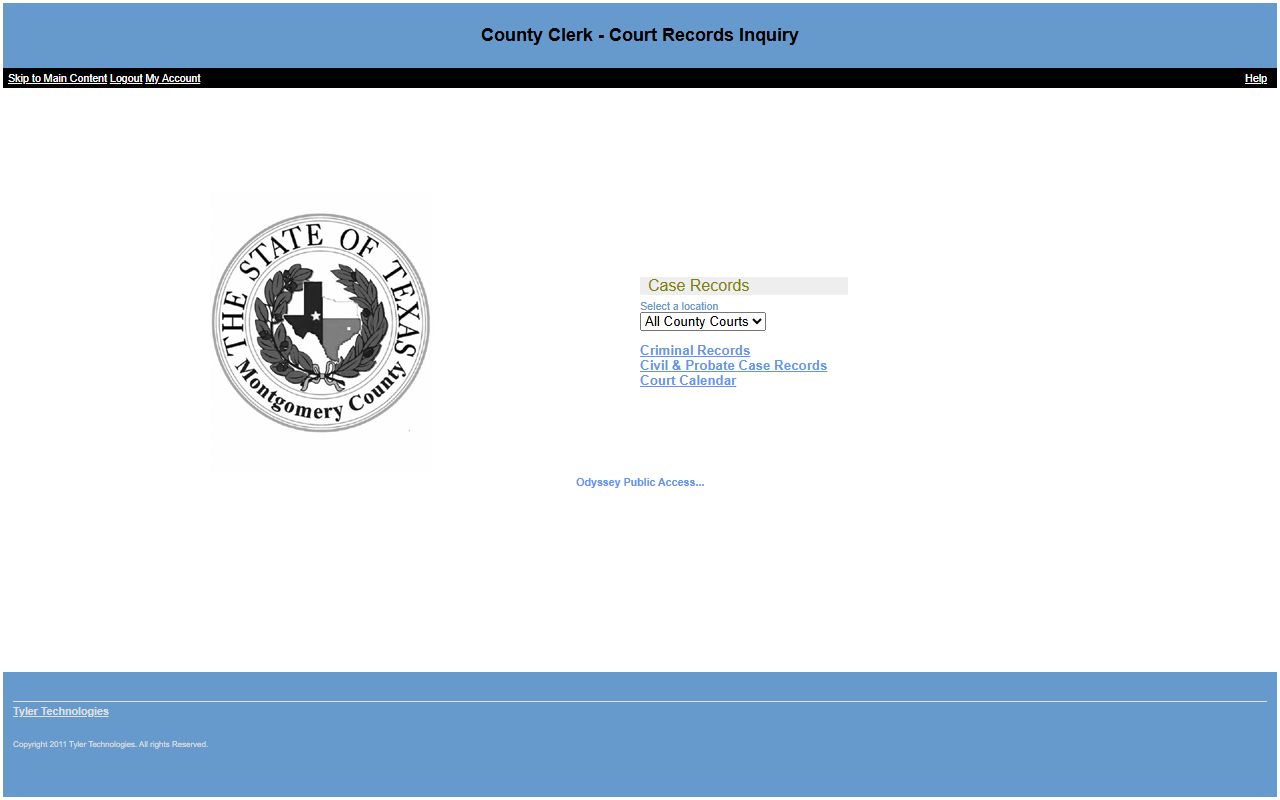
The court portal should be read as the case-record channel, while the jail roster remains the custody and booking channel.
Montgomery County Clerk Record Roles
Court records after a Montgomery County arrest may sit with different custodians. The Montgomery County District Clerk is the court record custodian for district-court filings. The Montgomery County County Clerk handles county-level court records, including misdemeanor and county-court channels. The DA prosecutes cases but is not the usual public file-copy substitute for the clerk.
| Office or Portal | Best Use | Record Type |
|---|---|---|
| Odyssey public access | Online case search | Filed charges, settings, case numbers, dispositions where public. |
| District Clerk | District-court copies and certified records | Felony and district-court criminal filings. |
| County Clerk | County-court record copies | Misdemeanor or county-level criminal court records. |
| District Attorney | Prosecution identity and victim services | Not the main copy office for public court files. |
| MCSO or GovQA | Jail and booking records | Booking reports, jail records, and booking-photo requests. |
Charges Filed After a Jail Arrest
Court records after a jail arrest are built from charging documents. Texas criminal cases may begin or move forward through a complaint, information, or indictment depending on the offense, court, and stage of review. These documents are more formal than a jail roster entry. They show what is actually filed in court after prosecutor review or grand-jury action.
| Document | Who Uses It | What It Means |
|---|---|---|
| Complaint | Officer or prosecutor | Often starts a case or supports early charging after arrest. |
| Information | Prosecutor | A prosecutor-filed charging document used in many non-indictment cases. |
| Indictment | Grand jury | A formal felony charging instrument returned by a grand jury. |
Montgomery County Charge Status
Charges can change after booking. A person may be booked on one charge, have bond set on that charge, and later face a different filed charge. The court record is where those changes are tracked after the case exists. Read each status in context, and do not treat a pending charge as a conviction.
| Status | What It Means |
|---|---|
| Pending | The filed charge or case has not reached a final disposition. |
| Amended | The prosecutor or court changed the charge or charging document. |
| Reduced | The charge was lowered to a lesser offense or lower level. |
| Dismissed | The charge ended without a conviction in that case. |
| Indicted | A grand jury returned a felony indictment. |
| Disposition | The case outcome, such as conviction, dismissal, acquittal, deferred adjudication, or plea. |
Bond After a Montgomery County Arrest
Bond is often visible as practical custody information, but it is set or changed through magistrate and court action. Texas Code of Criminal Procedure Chapter 17 governs bail and personal bond. Release is not instant after payment because the jail must verify the bond, clear holds, finish paperwork, and confirm that no other agency wants custody.
| Bond Type | How It Works | Practical Note |
|---|---|---|
| Cash bond | Money paid directly to secure release. | Refund or distribution depends on court rules and the case outcome. |
| Surety bond | A licensed bail bond company posts bond for a fee. | Confirm the company is licensed and that the jail or court will accept the bond. |
| Personal or PR bond | Release based on promise and court conditions rather than cash deposit. | May include supervision, reporting, or restrictions. |
| No-bond hold | Bond is not set or release is blocked. | Another charge, warrant, detainer, or court order may keep the person in custody. |
Warrants and Court Records After Arrest
The official Montgomery County warrant search portal lets users search active warrants by name or warrant number. It uses Cloudflare Turnstile and two search sections. A warrant can lead directly to a jail booking, and after arrest the jail roster may show custody while the court portal shows the case tied to the warrant. Municipal court warrants may require checking the relevant municipal court directly.
| Warrant Search Field | Required | Notes |
|---|---|---|
| Last name | Yes for name search | Validation requires a full last name. |
| First name | Yes for name search | At least the first letter is required. |
| Middle initial | No | Optional narrowing field. |
| Warrant Number | Yes for warrant-number search | Used instead of the name search path. |
| Cloudflare Turnstile | Yes to enable search | The portal asks users to verify they are human. |
Charges vs Convictions
A Montgomery County arrest record, booking charge, or filed charge is not the same as a conviction. A charge is an accusation that enters the court process. A conviction requires a plea, verdict, or other court outcome that legally resolves guilt. Court records after a jail arrest should be read by stage so an accusation is not overstated.
| Charge | Conviction | |
|---|---|---|
| Stage | Accusation or filed count. | Final guilt outcome by plea, verdict, or judgment. |
| Source | Jail booking, complaint, information, or indictment. | Court judgment or disposition. |
| Meaning | Case may still be pending, changed, or dismissed. | Case has reached a conviction result unless later changed by court action. |
Sealed and Expunged Arrest Records
Restricted records are not always visible through the same court search. Juvenile records, sealed records, expunged records, active investigations, and confidential data may be withheld from public view. Texas Code of Criminal Procedure Chapter 55 controls expunction of eligible criminal and arrest records. The Public Information Act still allows exceptions and redactions.
| Sealed or Restricted | Expunged | |
|---|---|---|
| Public Visibility | Hidden or limited for public users. | Removed or treated as not existing for many purposes after court order. |
| Access | Some agencies or courts may retain limited access. | Access depends on the expunction order and Texas law. |
| Common Trigger | Juvenile status, court restriction, confidentiality, or nondisclosure rules. | Eligible dismissal, acquittal, or other qualifying result under Chapter 55. |
Restricted Montgomery County Court Records
If an online court case search fails, the reason may be timing or legal access. Newly filed cases may not be indexed yet. Older cases may require clerk help. Juvenile matters, sealed filings, expunged arrests, active-investigation material, medical data, and protected personal identifiers can be withheld or redacted. For jail booking records, use MCSO or GovQA. For court filings, use Odyssey first and then the correct clerk.
Important: This site is not a consumer reporting agency, and court or jail information cannot be used for FCRA-covered decisions.
Public Record Search
Sponsored Results